A selection of previous publication highlights from the lab, from members past and present.
“Structural maturation of SYCP1-mediated meiotic chromosome synapsis by SYCE3”
Crichton JH, Dunce JM, Dunne OM, Salmon LJ, Devenney PS, Lawson J, AdamsIR, Davies OR. Nature Structural and Molecular Biology
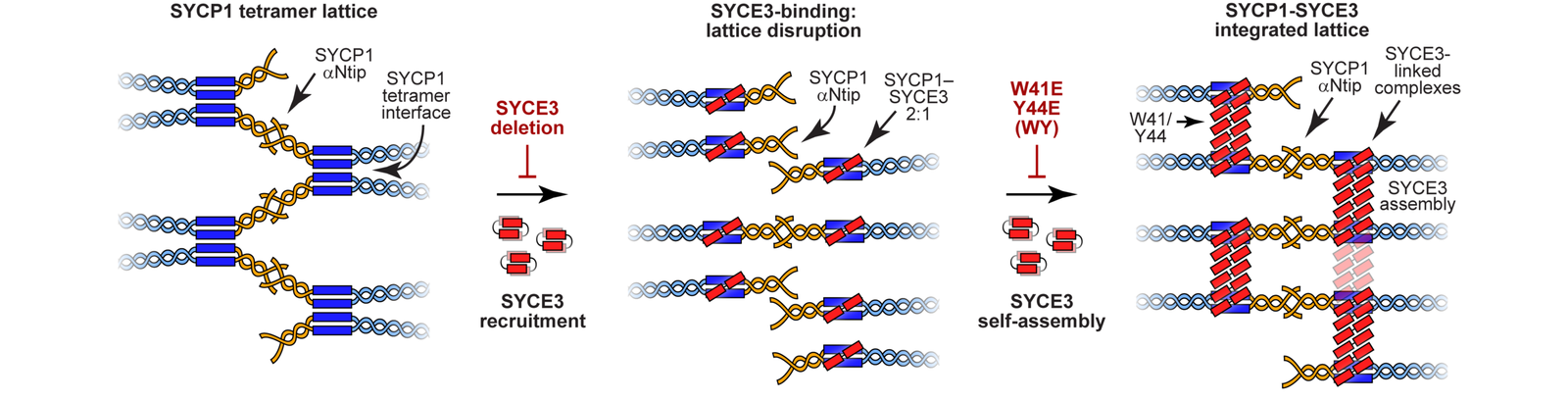
‘The process of swapping pieces of DNA between chromosomes, recombination, must occur during the specialised cell division that creates egg and sperm forre production. In order to recombine their DNA, ‘matching’ (homologous) chromosomes are physically bridged by the synaptonemal complex. The complex appears similar to a zipper in electron micrographs but how the proteins actually work together in the cell, so that the complex can hold chromosomes but allow for DNA movement, is unclear.In their study recently published in Nature Structural and Molecular Biology, scientists in the Davies and Adams (HGU, University of Edinburgh) groups led by Dr. James Crichton and Dr. James Dunce identified how the central element protein SYCE3 is required for the formation of a normal synaptonemal complex in cells by acting as a kind of adapter between different‘building block’ protein complexes.Initially they identified that SYCE3 interacts with the major lattice protein of the complex SYCP1 by yeast-two-hybrid assay as well as in vitro pull downs. The interaction between SYCP1 and SYCE3 was quite strong,with nanomolar affinity determined by ITC. SYCP1 forms tetramer (4 copies of SYCP1) complexes on its own but when SYCE3 was added they observed a 2:1 SYCP1-SYCE3 hetero-trimer by SEC-MALS. Based on their structural assays, they hypothesized that an interface required for SYCE3 self-assembly may be important for overall complex structure. They generated CRISPR-Cas9 modified mice in which SYCE3 was either deleted or carrying point mutations which disrupt SYCE3 self-assembly but not SYCE3-SYCP1 binding. Analysis of these animals revealed that the SYCE3 self-assembly interface mutant created worse defects in complex structure than animals missing SYCE3 entirely (∆/∆). Overall their data supports a model in which SYCE3 is a lynchpin in the assembly of the lattice-like but also dynamic synaptonemal complex.’ – Lori Koch
“Structural basis of meiotic chromosome synaptic elongation through hierarchicalfibrous assembly of SYCE2-TEX12”
Dunce JM, Salmon LJ, Davies OR. Nature Structure & Molecular Biology
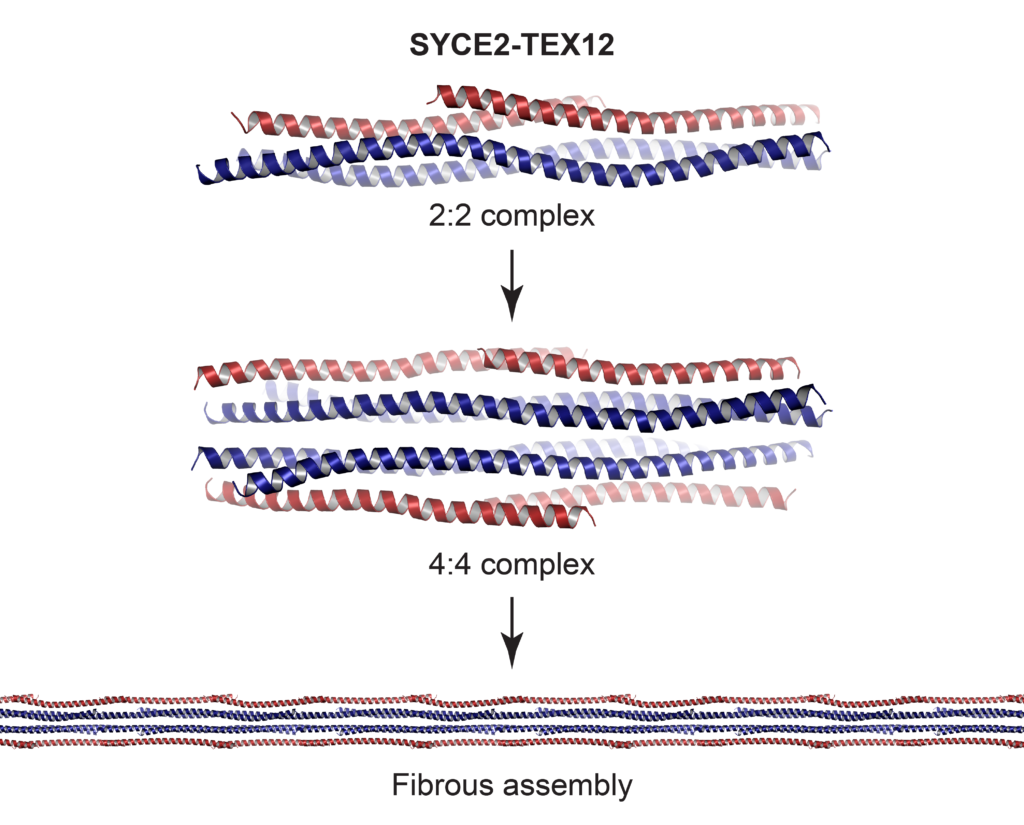
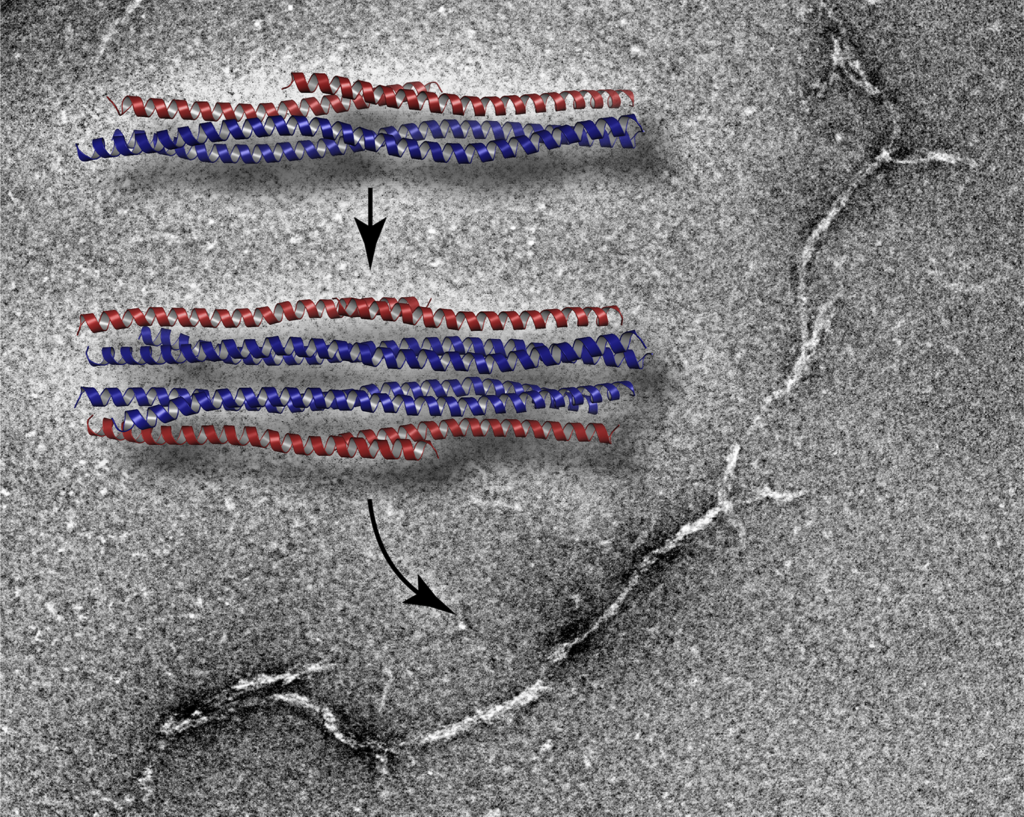
‘Meiosis is the specialised cell division that creates gametes such as egg and sperm.A trademark event in the process is when pairs of homologous chromosomes bindalong their lengths, enabling recombination which is the swapping of pieces of DNA between the chromosome inherited from the mother and the chromosome inherited from the father. A large protein complex called the synaptonemal complex physically bridges the chromosomes together. The proteins SYCE2 and TEX12 make up the central element and have been proposed to provide long-range structural support tothe synaptonemal complex. In their recent paper inNature Structure & MolecularBiology, scientists in Owen Davies’ group used X-ray crystallography, SEC-MALS,and electron microscopy (EM) to uncover how SYCE2-TEX12 complexes assemble into fibres. Using SEC-MALS and EM, they found that SYCE2-TEX12 is mainly alpha-helical and forms 2:2, 4:4 and larger complexes in solution but that assembly beyond the 2:2 stage requires the C-terminal tip of TEX12. The stability of theTEX12∆C complex allowed growth of protein crystals which diffracted to 2.42 and-3.336 Angstrom and both a 2:2 and 4:4 structures were as observed. Given that a 4:4S YCE2-TEX12∆C complex did not form in solution, the scientists hypothesized that this form was supported by the crystal lattice and so, guided by the structure, they made mutations to the region of TEX12 they hypothesized was important for stabilizing larger complexes. These mutations partially blocked formation of 4:4 complexes and further experiments revealed that an equivalent region at the end of SYCE2 also stabilized 4:4 complexes. Overall, their structural experiments show that in its most basic form SYCE2-TEX12 forms a 2:2 complex which then self-associates into a 4:4. Then, 4:4 complexes assemble via their ends to form 2 and 4 nanometre fibres, which assemble further into 10 nanometre and then 40 nanometre fibres reminiscent of classic intermediate filament proteins.’ – Lori Koch
“MEILB2-BRME1 forms a V-shaped DNA clamp upon BRCA2-binding inmeiotic recombination”
Manickam Gurusaran, Jingjing Zhang, Kexin Zhang, Hiroki Shibuya, OwenR. Davies. Nature Communications.
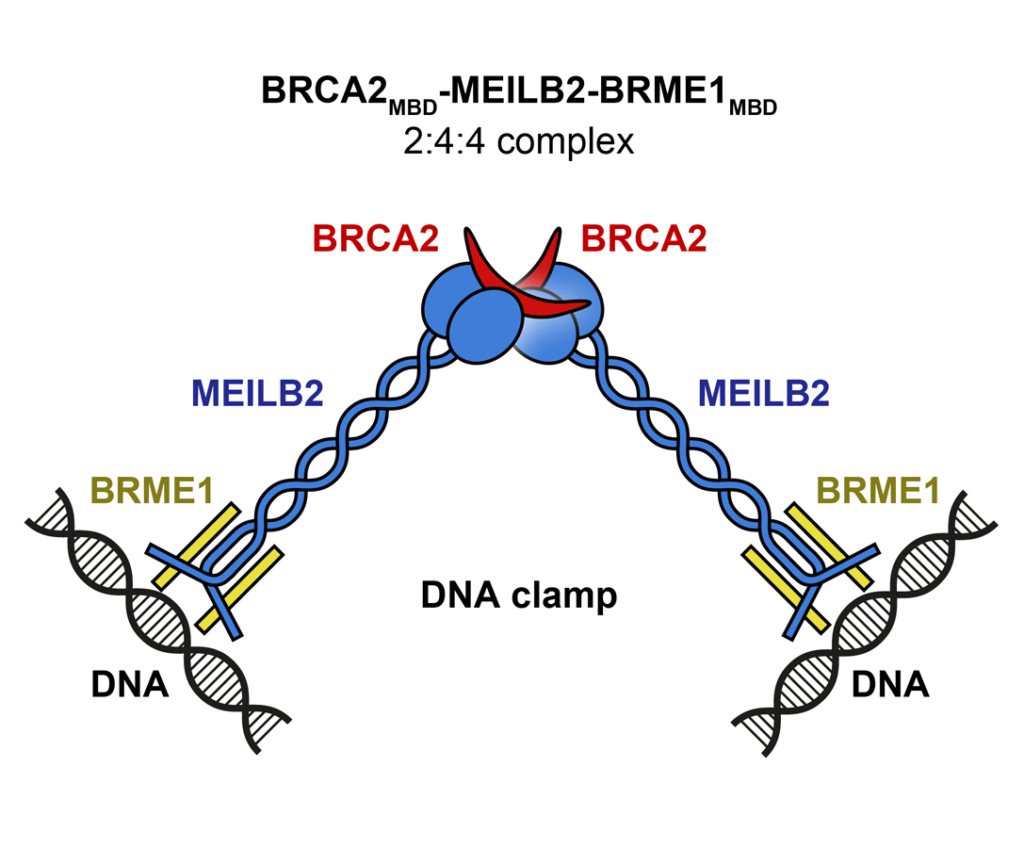
‘BRCA2 (Breast Cancer Susceptibility Protein 2), MEILB2 (Meiotic Localiser of BRCA2) andBRME1 (Break Repair Meiotic Recombinase Recruitment Factor 1) are proteins which arecrucial for meiosis-specific DNA double-strand (DSB) break repair by homologousrecombination, ensuring correct formation of haploid germ cells. While BRCA2 is alsoinvolved in mitotic DSB repair in somatic cells, homologous recombination in germline cellsrequires meiosis-specific accessory proteins, such as MEILB2 and BRME1, to interact withBRCA2 for functional strand repair.Previous studies showed that MEILB2 and BRME1 likely co-localise in a complex duringmeiosis and may be involved in directing the cellular decision between somatic versusmeiotic recombination via modulation of BRCA2 conformation. However, the exact functionof the protein assembly is still unclear due to lack of structural information.In their most recent paper, published inNature Communications, the Davies lab reportedthe crystal structure of the MEILB-BRME1 core complex how this may be involved in DNA-binding.The authors reveal a linear four-helical coiled coil MEILB2-BRME1 complex which isdimerized through C-terminal BRCA2 binding. The two MEILB2-BRME1 arms of the resultingV-shaped structure are positioned 25nm apart, allowing binding of two discrete DNAmolecules via their N-terminal ends. Overall, the extensive crystallographic and biochemicaldata provided by the lab suggests a model of a meiosis-specific BRCA2-MEILB2-BRME1 DNAclamp which functions to stabilise DNA ends during meiotic recombination.Furtherin vivoexperiments into the functional and structural significance of the complexwill ultimately give a better understanding of the molecular processes involved in meioticrecombination and DNA repair by homologous recombination, and the possibleconsequences for disease when these are perturbed.’ – Elena Hein